Withdrawals
Each year the app works out how much money your accounts must supply, and which accounts pay it. This page explains the Withdrawals card: the withdrawal method, the two switches for lean years, how each kind of draw is taxed, and where you can check the result.
Where to find it
The Withdrawals card is in the strategy part of the plan, below Healthcare and above Roth Conversions. Click ↓ Withdrawals in the header to jump to it. Click the ▼ arrow on the right of the card to fold or unfold it; the app remembers your choice.
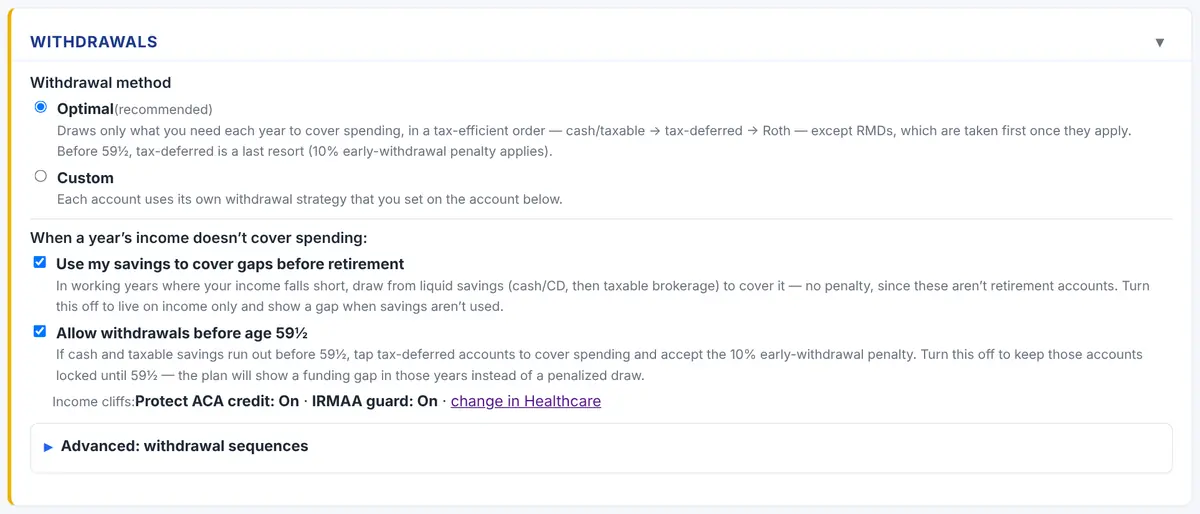
| Part of the card | What it does | Default |
|---|---|---|
| Withdrawal method | Optimal or Custom — who decides how much each account pays. | Optimal |
| Use my savings to cover gaps before retirement | Pays for short working years from savings and brokerage. Optimal only. | On |
| Allow withdrawals before age 59½ | Lets the plan use 401(k)s and IRAs before 59½, with the 10% penalty, when nothing else is left. | On |
| Income cliffs: | Shows whether the ACA and IRMAA guards are on. Appears when the plan has ACA or Medicare years. | — |
| Advanced: withdrawal sequences | Your own draw rules for chosen ages. See Withdrawal sequences. | Folded when empty |
Every change saves automatically, and the projection updates within a second or two.
Your yearly need
For every year of the plan, the app compares spending with the income that arrives anyway:
Need = spending (including healthcare) − income from other sources (salary, Social Security, pensions, other income)
- If the need is above zero, your accounts must pay it. These payments are withdrawals (also called draws).
- If the need is below zero, the year has extra money. The Surplus and Extra Money card decides where it goes.
- Whatever no account can pay is a shortfall: a red year in the Year-by-Year Projection with a Fix button.
How a year is paid
Every year, the app takes money in this order:
| Step | What happens |
|---|---|
| 1. Required minimums | Required minimum distributions (RMDs) come out of traditional accounts first, whether you need the money or not. They start at 73, or 75 if you were born in 1960 or later. |
| 2. Your "always drawn" sequences | Any withdrawal sequence set to Fixed, Percent of balance, RMD or Dividend takes its amount. |
| 3. Your "cover shortfall" sequences | These fill what is still missing, account by account, within their limits. |
| 4. Your method tops up | Optimal pays the rest in its tax-smart order. Custom uses each remaining account's own strategy. |
| 5. What's left | Still missing = a shortfall year. Too much = a surplus. |
Most plans have no sequences, so only steps 1, 4 and 5 apply.
Choose a withdrawal method
Optimal (recommended)
Optimal draws only what you need each year, in an order that keeps taxes low:
- RMDs, once they apply.
- Taxable Brokerage, then Savings / CD / Money Market — money that was already taxed.
- Traditional accounts: an inherited IRA first, then 401(k), 403(b), 457(b), SEP IRA, SIMPLE IRA and traditional IRA.
- Roth accounts (inherited Roth, Roth 401(k), Roth IRA), then the HSA — tax-free money is kept longest.
Before 59½, traditional accounts are a last resort, because a 10% penalty applies. Accounts that qualify for the Rule of 55 are drawn before penalized ones.
Under Optimal, each account's Withdrawal Strategy in Income → Investments & Accounts is replaced by the badge ⚙ Managed by Optimal withdrawals. Its link Change under Withdrawals → brings you back here. You can still set a Withdrawal Start Age on an account to keep Optimal away from it until that age.
Custom
With Custom, each account uses its own Withdrawal Strategy, set on the account (see Investments & Accounts):
| Strategy | Draws each year |
|---|---|
| 4% Rule (recommended) | 4% of the balance in the first year, then that amount grows each year. |
| Fixed Dollar Amount | The amount you enter, growing by the Withdrawal Growth Rate (%/yr) (blank = plan inflation). |
| Fixed Percentage | A percent of the balance each year. |
| IRS Required Minimum Distribution | Only the RMD, nothing before RMD age. |
| Dividend / Yield Income | Balance × the Dividend / Yield Rate (% per year); the principal stays invested. |
Custom strategies do not look at your need, so some years end in a shortfall and others in a surplus. A traditional account always pays at least its RMD. Use Custom when you want predictable amounts from specific accounts.
Tip: Leave Optimal selected unless you have a reason to set amounts yourself. To control just a few years or accounts, keep Optimal and add a withdrawal sequence.
When a year's income doesn't cover spending
Use my savings to cover gaps before retirement
This switch covers years before your retirement age when income is less than spending — for example, when one of you has stopped working and the other still works. With it on, Optimal pays the gap in this order (the "bridge"):
- Savings / CD / Money Market, then Taxable Brokerage — no penalty, since these are not retirement accounts.
- When those run out: traditional accounts — from 59 without penalty, or earlier only if Allow withdrawals before age 59½ is on.
- Roth accounts last, and only from 59.
These years show · from accounts in the Surplus / Shortfall column of the projection. Turn the switch off to live on income only before retirement; the gap then shows as a shortfall. Under Custom the switch is greyed out and says (applies to Optimal).
Allow withdrawals before age 59½
Taking money from a 401(k), 403(b) or IRA before age 59½ usually costs a 10% IRS penalty on top of income tax. The app treats ages under 59 as "before 59½".
| Setting | What happens when savings and brokerage are gone before 59½ |
|---|---|
| On (default) | Traditional accounts are drawn to cover spending. The draw is taxed and the 10% penalty is added. A Penalties column appears in the projection, and Plan Alerts lists the cost. |
| Off | Traditional accounts stay locked until 59½. Those years show a red shortfall instead. |
Turn it off if you would rather see the gap — for example, to plan part-time work. Under Custom, the switch applies to each account's own strategy. A withdrawal sequence always draws at the ages you set, even before 59½, and pays the penalty.
Other penalties the app models: 25% for a SIMPLE IRA in its first 2 years, and 20% for non-medical HSA withdrawals before 65. 457(b) plans have no early-withdrawal penalty.
How draws are taxed
| Account | Tax on a withdrawal |
|---|---|
| Savings / CD / Money Market | None on the principal. Interest is taxed each year as it is earned. |
| Taxable Brokerage | With a Cost basis ($) entered on the account, each draw is split: the cost-basis part comes back tax-free and the gain is taxed at capital-gains rates. Left blank (Unknown), the whole draw is taxed as ordinary income. |
| Traditional 401(k), 403(b), 457(b), IRA, SEP, SIMPLE | Ordinary income. |
| Roth 401(k), Roth IRA | Tax-free. |
| HSA | Tax-free for medical costs; non-medical draws before 65 are taxed and penalized. |
All draws count toward your income for ACA premium help this year and for Medicare IRMAA two years later. See Medicare IRMAA.
Note: These are planning estimates, not tax advice. Check current IRS rules at irs.gov or with a tax professional.
Income-cliff guards
Two guards on the Healthcare screen can change which account pays, so that a large traditional-account draw doesn't push your income over a costly line:
- the ACA guard protects premium tax credits before Medicare;
- the IRMAA guard avoids higher Medicare premiums.
When the guard would cross the line, the rest of the year's spending comes from Roth instead. The card shows their status on one line, for example Income cliffs: Protect ACA credit: On · IRMAA guard: On · change in Healthcare. When a guard is off, the line may add an estimate such as "could keep ~$X/yr". Under Custom it adds (works with Optimal withdrawals only). See Healthcare and Medicare IRMAA.
Draws from the Shortfall Wizard
The Shortfall Wizard has a lever, Draw From Cash/Brokerage, that schedules withdrawals from savings or brokerage for chosen years. Fixed amount draws a set amount each year; Cover shortfall draws exactly each year's gap, up to an optional Annual Cap ($, optional). When you apply the fix, these draws are saved with the plan. For draws you want to see and change later, use a withdrawal sequence instead.
Check where the money came from
- Scroll to the Year-by-Year Projection.
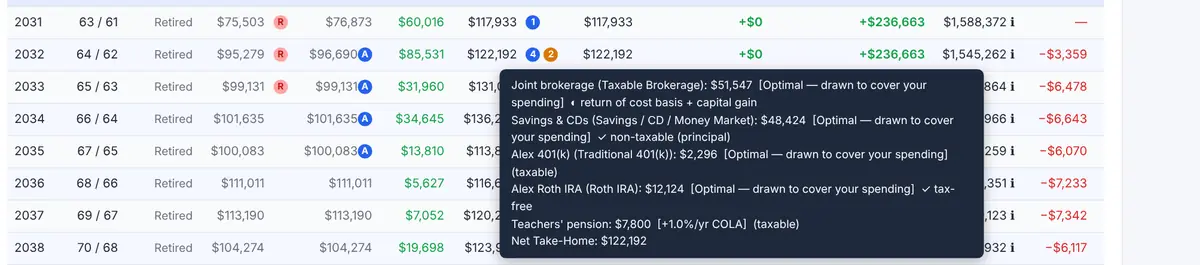
- Hover a Total Income cell. The tooltip lists each draw with its account, amount and reason, for example:
- [Optimal — drawn to cover your spending] — a normal draw.
- [Optimal — required minimum withdrawal (IRS rule for your age)] — an RMD.
- [Optimal — covered from savings (drawn to cover your spending)] — a bridge year from savings.
- [Optimal — drawn before 59½ to cover your spending; 10% early-withdrawal penalty applies].
- [withdrawal sequence] after the sequence name — a sequence draw.
- Each line also says how it is taxed: ✓ non-taxable (principal), ◐ return of cost basis + capital gain or (taxable).
- Open Account Balances to see when an account runs out, and Plan Alerts for penalties.
The Stress Test, Monte Carlo, Shortfall Wizard, Social Security optimizer, AI advisor and PDF report all use the same withdrawal rules.
Example: the Rivera family
Alex works at Northwind Logistics until 62 (the plan's retirement age). Sam leaves Lakeview School District at 58, two years before Alex retires. The plan uses Optimal with both switches on.
| Years | Who earns | What pays the gap |
|---|---|---|
| Sam 58 until Alex 62 | Alex's salary only | If Alex's pay doesn't cover spending, the bridge draws Savings & CDs, then Joint brokerage. If those ran out, Sam's 403(b) could be used without penalty under the Rule of 55. |
| Alex 62–66 | No salary; Sam's pension from Sam's 62 | Optimal draws brokerage and savings first, then traditional accounts. The Roth conversion fills the 22% bracket in these years. |
| Alex 67 on | Both Social Security benefits at 67, plus the pension | Draws shrink. RMDs start at 75 for both (born 1960 or later). |
| Alex 75 | Home sold to downsize | The sale and any RMDs above need go to Surplus and Extra Money. |
To try it yourself:
- Turn Use my savings to cover gaps before retirement off and watch for red years while Sam has stopped working.
- Turn it back on and hover Total Income in those years to see Savings & CDs paying.
Good to know
- Under Optimal, Surplus / Shortfall is about $0 in normal years, because the plan draws exactly the need. A surplus usually means RMDs or a home sale brought in more than you spend.
- A shortfall while accounts still have money? Check, in order: a late Withdrawal Start Age; Allow withdrawals before age 59½ is off; Custom strategies draw too little; or the bridge switch is off.
- Amounts in the projection are in the dollars of each year, not today's dollars.