Rule of 55
If you leave your job in or after the year you turn 55, you may take money from that job's 401(k) or 403(b) without the usual 10% early-withdrawal penalty. This page shows how the app models that rule and where you see its effect.
What the rule says
Taking money out of a retirement account before age 59½ usually costs a 10% IRS penalty on top of income tax. The Rule of 55 is an exception:
- You leave your employer in or after the calendar year you turn 55 (50 for qualifying public-safety workers in a governmental plan).
- You can then draw from that employer's plan with no penalty. You still pay income tax.
- It counts the age you turn in the year you leave, not your age on the day you leave. Leaving in March of the year you turn 55 still qualifies.
Note: This is a planning estimate, not tax advice. Read the IRS rules on exceptions to the early-withdrawal tax at irs.gov, and ask your plan administrator what your plan allows.
Who qualifies
| Account | Rule of 55? |
|---|---|
| Traditional 401(k), Roth 401(k), 403(b) | Yes — the plan of the job you leave at the qualifying age. |
| Traditional IRA, SEP IRA, SIMPLE IRA, inherited accounts | No. IRAs never qualify. |
| 457(b) | Not needed — it has no early-withdrawal penalty anyway. |
| Plans from earlier jobs | No, unless you roll them into the current job's plan before you leave. |
Draws taken while you still work there ("in-service" withdrawals) do not qualify.
Where to find it
- Open Income → Investments & Accounts (see Investments & Accounts).
- Expand a workplace account (401(k), Roth 401(k) or 403(b)).
- Below the Withdrawal part is the Rule of 55 row.

Set up the Rule of 55 row
| Field | What it means | Default |
|---|---|---|
| Status | A short line, for example "✓ Penalty-free from age 58 — you leave … at 58" or "⚠ You leave at 53 — the Rule of 55 needs 55 or later". | — |
| Age you turn in the year you leave | The age you turn in the calendar year you leave (or left) this employer. Leave blank to use the linked job's End Age; the row then shows "from your … job" and the year. | From the job |
| Use the job's end age | Appears after you type an age. Click it to go back to the job's end age. | — |
| Public-safety employee (governmental plan) | Police, firefighters, EMTs, corrections officers and some other public-safety workers can use the rule from 50. | Off |
| Apply the Rule of 55 | Turn off if your plan pays only a lump sum after you leave, or if you will roll the money to an IRA. | On |
To link the account to a job, use Link to Employment on the account. The app uses a job only if it belongs to the same person and is not self-employment. Otherwise the status asks you to enter the age.
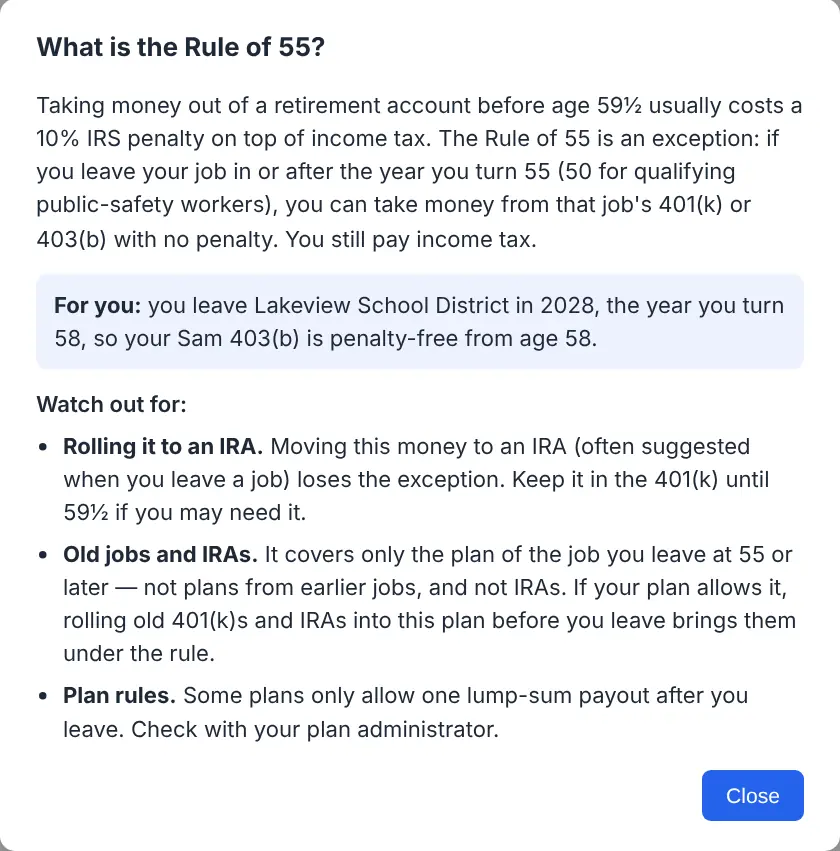
What's this? next to the status opens a short explainer, What is the Rule of 55?, with what it means for your account and what to watch out for.
What changes in your plan
When the rule applies:
- Penalty column. In the Year-by-Year Projection, the Penalties column shows $0 ✓ in those years. Hover it to read "Rule of 55 saved you … this year." Click it to open the explainer.
- Optimal order. Before 59½, the Optimal method draws penalty-free accounts — Rule of 55 accounts, 457(b) and inherited accounts — before penalized ones. On the account card, the Optimal note says the account "has no early-withdrawal penalty (Rule of 55)" from that age.
- Hover labels. A draw shows [Optimal — drawn before 59½ to cover your spending; penalty-free under the Rule of 55] in the Total Income tooltip.
- Shortfall Wizard. Moving a job's end age in the wizard also moves the age you leave.
- AI advisor and PDF report include one line per account about the rule.
Plan Alerts it shows
| Alert | When it appears |
|---|---|
| Good news: the Rule of 55 avoids a penalty | The rule applies and saves you money. It reminds you to keep the money in the plan until 59½. |
| Working a little longer could avoid a penalty | Your job ends one to five years before the year you turn 55 (50 for public-safety workers). |
| When do you leave this employer? | The app can't tell when you leave. The 10% penalty stays included until you link the job or enter the age. |
| Withdrawals while still working don't qualify | The plan draws the account while you still work there. |
See Plan Alerts for how to read and dismiss alerts.
What the app doesn't model
- 72(t) / substantially equal periodic payments.
- The SECURE 2.0 route for public-safety workers with 25 years of service.
- Being rehired by the same employer.
- Whether your plan allows partial withdrawals after you leave. If it pays only a lump sum, turn Apply the Rule of 55 off.
- Income tax on Roth 401(k) earnings drawn before they qualify.
Example: the Rivera family
Sam works for Lakeview School District and has the Sam 403(b) linked to that job. The job's End Age is 58.
- Open Income → Investments & Accounts and expand Sam 403(b).
- Leave Age you turn in the year you leave blank. It uses 58 from the Lakeview job.
- Leave Public-safety employee (governmental plan) off — the rule's age 55 applies.
- Leave Apply the Rule of 55 on.
The status shows Sam is penalty-free from 58, because Sam leaves in the year Sam turns 58. If the plan needs money from the 403(b) before Sam is 59½, it pays no 10% penalty. If Sam had planned to leave at 54, the status would warn that the rule needs 55 or later, and Plan Alerts would suggest working a little longer.
Good to know
- Rolling the money to an IRA when you leave loses the exception. Keep it in the plan until 59½ if you may need it.
- After 59½ there is no early-withdrawal penalty anyway, so the status says the rule is not needed.
- The rule covers only the employer you leave at the qualifying age — not older plans or IRAs.