Social Security
Enter your Social Security estimates and the age you plan to claim. The optimizer then shows how each claiming age from 62 to 70 changes your whole plan.
Important: The app's Social Security results are planning estimates, not advice. When to claim is a personal choice that depends on your health, your family and other income. Check your figures with the Social Security Administration at ssa.gov.
Where to find it
Open the Income card and click the Social Security tab. There is one card for you and, in a married plan, one for your spouse. The card header shows the owner, claim age 67 (for example) and the projected monthly benefit.

Get your estimates
Your estimates come from your Social Security statement:
- Sign in at ssa.gov/myaccount (create a free account if you don't have one).
- Open your statement. It shows your estimated monthly benefit at 62, at your full retirement age (67 for anyone born in 1960 or later), and at 70.
- Keep the statement open while you fill in the card.
Add a Social Security entry
- Click + Add SS Entry.
- Pick the Owner: Self or Spouse. Each person can have one entry.
- Choose how you will enter the benefit:
- Use SSA estimates (I'll use the optimizer) — type Monthly benefit at 62, Monthly benefit at 67 and Monthly benefit at 70 from your statement.
- I know my exact monthly benefit — type one Monthly benefit ($). Use this if you already receive Social Security or know the exact amount.
- Type your Claiming Age, from 62 to 70. A number outside that range is put back as it was, with a message.
- Click 💾 Save Social Security. Later changes are saved on their own.
For a claiming age between the three points (for example 65), the app works out the benefit between the two nearest amounts.
| Field | What it means |
|---|---|
| Monthly benefit at 62 | The lowest benefit: claiming early reduces it for life. |
| Monthly benefit at 67 | Your full retirement age benefit (for most people today). |
| Monthly benefit at 70 | The highest benefit: each year you wait past full retirement age adds about 8%. |
| Claiming Age | When payments start. |
How the plan uses your benefit
- Start: payments start in the year you reach your claiming age.
- First year: if you entered a Birth Month, the first year only counts the months from your birthday to December. See Why birth month matters.
- Yearly increases: the benefit grows each year with the plan's inflation rate, like Social Security's cost-of-living adjustment (COLA).
- Taxes: 0%, up to 50% or up to 85% of the benefit is taxable, depending on your other income. See How much Social Security is taxed.
- Survivor: in a married plan, after the first death only the larger of the two benefits continues.
Your projected benefit also appears as an auto row on the Other Income tab.
Find a good claiming age: the optimizer
- Open a Social Security card that uses SSA estimates.
- Click ⚡ Calculate next to Claiming Age.
- After Running optimizer…, the SS Claiming Age Optimizer opens under the card.
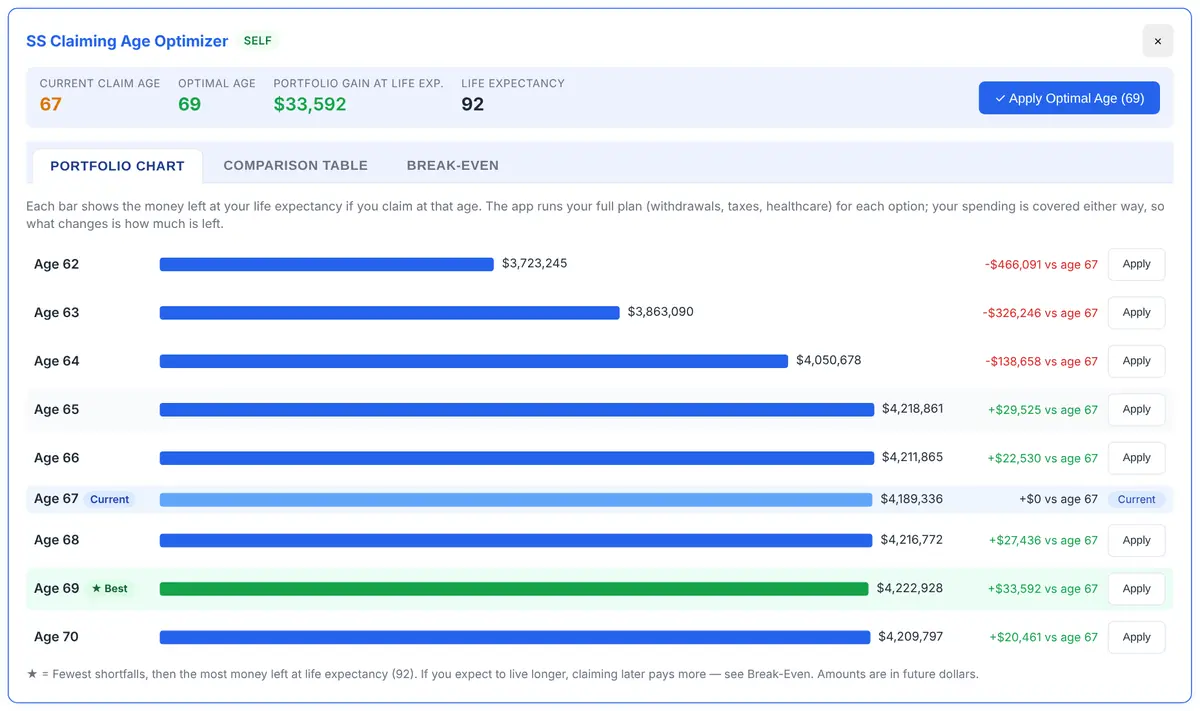
The optimizer runs your whole plan nine times, once for each claiming age from 62 to 70: income, taxes, withdrawals and healthcare. It keeps everything else the same.
The strip at the top shows:
| Box | What it shows |
|---|---|
| Current Claim Age | The age on your card now |
| Optimal Age | The age that scores best (see below) |
| Portfolio Gain at Life Exp. or Lifetime Income Gain | How much better the optimal age is than your current age |
| Life Expectancy | The life expectancy the result is based on |
If the optimal age is different from yours, ✓ Apply Optimal Age (70) (for example) sets it on your card.
What "optimal" means
The optimizer ranks the ages in one of two ways, depending on your plan's Withdrawal method:
| Withdrawal method | "Best" means | Why |
|---|---|---|
| Optimal | Fewest shortfall years, then the most money left at your life expectancy | The app covers your spending either way, so what changes is how much is left. |
| Custom | The highest lifetime after-tax income | Account withdrawals are fixed, so what changes is your total income after tax. |
The best age is marked ★ Best. Your age now is marked Current.
Note: The result depends on your life expectancy. If you expect to live longer than the life expectancy in the plan, claiming later usually pays more. Look at the Break-Even tab.
The three tabs
Portfolio Chart — one bar per age. The bar shows the value the optimizer ranks on. Next to it you see the difference vs age 67. Click Apply on any row to use that age.
Comparison Table — every age side by side:
| Column | What it shows |
|---|---|
| Claim Age | The age tested (★ = best, "now" = current) |
| Portfolio at Life Exp. | Money left in your accounts at your life expectancy |
| Total SS Income | All Social Security received, with yearly increases |
| After-Tax Income | All income over your lifetime, minus estimated taxes |
| Total Tax Paid | Estimated taxes over your lifetime |
| Shortfall Years | Years when expenses are more than income. Point at ⚠ to see the worst age. |
| Gain vs Age 67 | Difference from claiming at 67 |
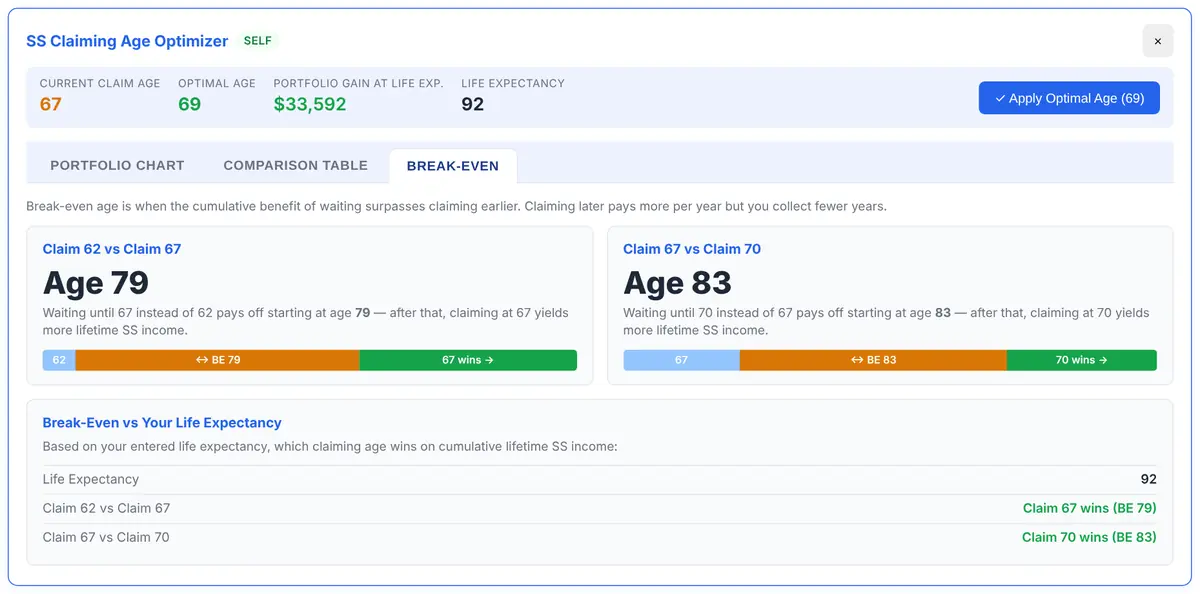
Break-Even — two comparisons: Claim 62 vs Claim 67 and Claim 67 vs Claim 70. Each says from which age waiting pays off, for example "Waiting until 70 instead of 67 pays off starting at age 83". Below that, Break-Even vs Your Life Expectancy shows which claiming age wins for the life expectancy in your plan.
The optimizer runs for one person at a time. Run it for your spouse from their own card. Close it with ×.
Example: the Rivera family
| Alex (Self) | Sam (Spouse) | |
|---|---|---|
| Monthly benefit at 62 | $2,150 | $1,500 |
| Monthly benefit at 67 | $3,050 | $2,140 |
| Monthly benefit at 70 | $3,790 | $2,650 |
| Claiming Age | 67 | 67 |
| Birth month | April | September |
- Alex reaches 67 in 2035. With an April birth month, the first year counts 9 months of payments.
- Sam reaches 67 in 2037. With a September birth month, the first year counts 4 months.
- The Riveras use Optimal withdrawals, so the optimizer ranks the ages by money left at life expectancy (92 for Alex).
- After Alex's final year, Sam keeps the larger of the two benefits.
Good to know
- ⚡ Calculate isn't shown when you use I know my exact monthly benefit. The optimizer needs the 62/67/70 amounts.
- Changing other parts of the plan can change the optimal age. Run the optimizer again after big changes.
- Amounts in the optimizer are in future dollars, not today's.
- The app doesn't model spousal benefits or the earnings test for working while you claim before full retirement age. Your SSA statement and ssa.gov explain these.
See also
- You and your spouse — birth month and survivor
- Inflation and taxes
- Withdrawals
- Year-by-year projection
- Glossary