Investments and accounts
Enter every account you save in: workplace plans, IRAs, Roth accounts, brokerage, savings and an HSA. The app grows each balance, adds your contributions, and draws from the accounts in retirement.
Where to find it
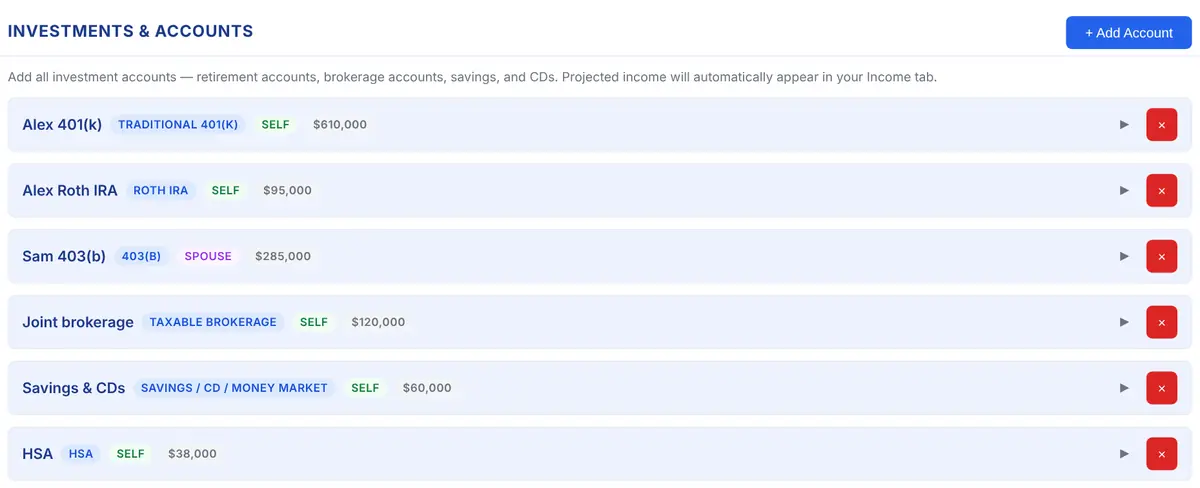
Open the Income card and click the Investments & Accounts tab. Each account is a card. Click a card's header to open or close it. The header shows the account name, its type, the owner, the balance today and, once it pays out, the yearly amount.
Add an account
- Click + Add Account.
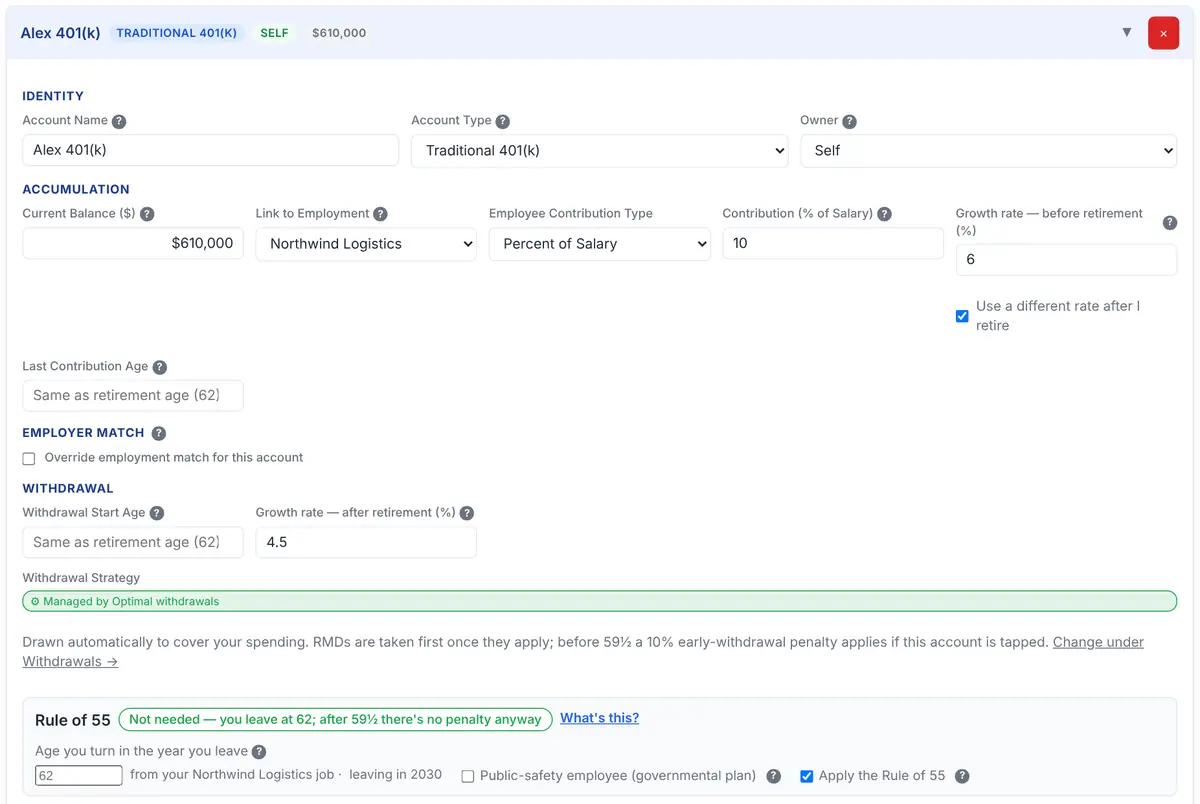
- The app adds an account called "My Account" and opens it, with the name selected. Type a name, for example "Alex 401(k)".
- Pick the Account Type and the Owner (Self or Spouse).
- Type the Current Balance ($).
- Fill in contributions and withdrawals (below).
- Click 💾 Save Account or Close.
Once an account exists, the app saves each change on its own about a second after you stop typing. Closing the card, or opening another one, also saves.
Account types
| Account Type | What it is | How withdrawals are taxed |
|---|---|---|
| Traditional 401(k), 403(b) | Workplace plan, pre-tax money | Ordinary income. 10% penalty before 59½ unless an exception applies. |
| 457(b) | Government workplace plan | Ordinary income. No 10% early-withdrawal penalty. |
| Roth 401(k) | Workplace plan, after-tax money | Tax-free |
| Traditional IRA, SEP IRA, SIMPLE IRA | Individual or small-business plans, pre-tax | Ordinary income. 10% penalty before 59½. A SIMPLE IRA in its first 2 years: 25%. |
| Roth IRA | After-tax individual account | Tax-free |
| Taxable Brokerage | Regular investment account | Only the gain is taxed, at capital-gains rates, when you give a Cost basis ($). Interest and dividends are taxed each year. |
| Savings / CD / Money Market | Bank savings | The money you take out isn't taxed again; the interest is taxed each year. |
| HSA | Health savings account | Tax-free. The plan assumes the money pays for medical costs. |
| Inherited IRA, Inherited Roth IRA | An account you inherited from someone other than your spouse | Paid out on the SECURE Act schedule. Inherited IRA payouts are ordinary income. |
Note: Tax treatment here is simplified for planning. It is not tax advice.
Balance and growth
| Field | What it means | Default |
|---|---|---|
| Current Balance ($) | What the account is worth today | 0 |
| Expected annual growth (%) | Average yearly return | 6% |
| Use a different rate after I retire | Tick to set one rate before and another after retirement | off |
| Growth rate — before retirement (%) / Growth rate — after retirement (%) | Shown when the box is ticked. Many people expect lower returns after retiring, as they move to safer investments. | — |
Brokerage cost basis
For a Taxable Brokerage account, enter Cost basis ($): what you paid for what you hold. It is on your brokerage statement (or the balance minus the "unrealized gain").
With a cost basis, each withdrawal is split. The part that is your money back is tax-free. Only the gain is taxed. If you leave it blank (Unknown), withdrawals are taxed in full as ordinary income, which overstates your tax.
Brokerage and savings accounts also have Yearly taxable yield: Interest %, Qualified dividends %, Fund capital-gain distributions % and Tax-exempt (muni) interest %. These are taxed every year, even when reinvested. Leave them blank (blank = default) to use typical values.
Contributions
- Optional: in Link to Employment, pick the job that pays into this account. Its salary is then used for percent contributions and the employer match. Without a link, type an Annual Salary ($) instead.
- Pick Employee Contribution Type:
- No Contribution
- Percent of Salary — then Contribution (% of Salary).
- Dollar Amount — then Annual Contribution ($).
- Optional: Last Contribution Age. Blank means contributions stop at the owner's retirement age.
Contributions are capped at the IRS limits when the linked job has Enforce IRS Contribution Limits? set to Yes. See Inflation and taxes.
Tip: A ⚠ next to Last Contribution Age on an HSA means you would still pay in after Medicare starts. That counts as an excess contribution.
Employer match
For a linked account, the match comes from the job's Default Employer Match. To use a different match for this account only, tick Override employment match for this account. Then pick Employer Match Type: No Employer Match, Flat Dollar Amount per Year or Percentage of Salary.
Brokerage, savings and inherited accounts have no employer match.
Withdrawals
Withdrawal Start Age is when the account starts paying out. Blank means the owner's retirement age. If the age is already past, withdrawals start this year.
How much is drawn each year depends on the plan's Withdrawal method in the Withdrawals card:
| What you see under Withdrawal Strategy | Why |
|---|---|
| ⚙ Managed by Optimal withdrawals | The plan uses Optimal. The app draws only what you need each year, in a tax-efficient order. Click Change under Withdrawals → to see or change the method. |
| ⚙ Managed by Withdrawal Sequence | A withdrawal sequence you made controls this account. |
| A list of strategies | The plan uses Custom. You choose a strategy for this account. |
Under Custom, the choices are:
| Strategy | What it draws each year |
|---|---|
| 4% Rule (recommended) | 4% of the balance in the first year, then that amount grows each year by Withdrawal Growth Rate (%/yr) (blank = plan inflation) |
| Fixed Dollar Amount | Annual Withdrawal Amount ($), optionally growing by the withdrawal growth rate |
| Fixed Percentage | Annual Withdrawal % (of balance) of each year's balance |
| IRS Required Minimum Distribution | Only the required minimum, from the owner's RMD age |
| Dividend / Yield Income | Dividend / Yield Rate (% per year) of the balance; the principal stays |
See Withdrawals and Withdrawal sequences.
Required minimum distributions
From a certain age, the IRS requires you to take money out of pre-tax accounts each year: a required minimum distribution (RMD).
| Born | RMDs start at |
|---|---|
| 1951–1959 | 73 |
| 1960 or later | 75 |
The app always takes at least the RMD from traditional 401(k), 403(b), 457(b), IRA, SEP and SIMPLE accounts, whatever the strategy. Roth IRAs and Roth 401(k)s have no RMDs for the owner.
Warnings next to the start age
| Mark | Meaning |
|---|---|
| ⚠ early withdrawal | A 10% penalty may apply at this age. |
| ℹ Rule of 55 | This age is penalty-free under the Rule of 55. |
| ⚠ SIMPLE IRA | The 25% penalty may apply in the first 2 years. |
| ⚠ RMD | The start age is after the RMD age. A missed RMD has a 25% tax. |
| ⚠ Roth 5-year | Earnings may be taxed if the Roth is less than 5 years old. |
Rule of 55
Workplace plans — 401(k), Roth 401(k) and 403(b) — show a Rule of 55 row. If you leave that employer in or after the year you turn 55 (50 for some public-safety workers), withdrawals from that plan have no 10% penalty. The row shows Age you turn in the year you leave, Public-safety employee (governmental plan) and Apply the Rule of 55. See Rule of 55.
Example: the Rivera family
| Account | Type | Owner | Balance | Notes |
|---|---|---|---|---|
| Alex 401(k) | Traditional 401(k) | Self | $610,000 | Linked to Northwind Logistics, 10% of salary, 4% match from the job |
| Alex Roth IRA | Roth IRA | Self | $95,000 | |
| Sam 403(b) | 403(b) | Spouse | $285,000 | Linked to Lakeview School District, 8% of salary |
| Joint brokerage | Taxable Brokerage | Self | $120,000 | Cost basis $85,000 |
| Savings & CDs | Savings / CD / Money Market | Self | $60,000 | |
| HSA | HSA | Self | $38,000 |
The Riveras use Optimal, so every card shows ⚙ Managed by Optimal withdrawals. Both were born after 1959, so their RMDs start at 75.
Good to know
- Each account's projected income also appears as an auto row on the Other Income tab.
- Deleting an account asks first. It also removes withdrawals and Roth conversions that use it.
- A joint account still needs one owner in the app. Pick the person whose ages should apply.
See also
- Withdrawals
- Roth conversions
- Rule of 55
- Healthcare — HSA and Medicare
- Glossary