Retirement income planner: withdrawal strategy and RMDs
In retirement, your paycheck comes from Social Security, pensions and your savings. Which account you take money from — and when — changes how much tax you pay and how long your money lasts.
Which account to withdraw from first
A common order is taxable savings first, then traditional IRAs and 401(k)s, then Roth accounts last, so tax-free money grows the longest. A better plan often mixes them: take traditional money up to the top of a low tax bracket every year, even before you need it, so later RMDs and taxes on Social Security are smaller.
Required minimum distribution (RMD) calculator
Traditional IRAs and 401(k)s require a minimum withdrawal every year from age 73 or 75. Enter your numbers:
Your 2026 RMD: $19,607.84 — $500,000 ÷ 25.5, the IRS factor for age 74.
Uses the IRS Uniform Lifetime Table. If your spouse is more than 10 years younger and your only beneficiary, a different table gives a smaller RMD. Inherited accounts follow other rules.
🔒 This calculator runs in your browser. Nothing you type here is sent anywhere.
This app is an educational planning tool, not financial, tax or legal advice.
The 4% rule and other withdrawal strategies
Taking 4% of savings in the first year and raising it with inflation is a simple start. Other strategies take a fixed percentage of the balance each year, spend only dividends, or take only what is needed after other income. The retirement calculator shows how long a withdrawal lasts.
Penalties to avoid
- Withdrawals from traditional IRAs and 401(k)s before 59½ usually pay a 10% penalty on top of income tax.
- The Rule of 55: if you leave your job in or after the year you turn 55, withdrawals from that employer's 401(k) or 403(b) have no 10% penalty. IRAs don't qualify.
- Missing an RMD costs a 25% excise tax on the amount not taken, cut to 10% if you correct it quickly.
- HSA withdrawals for anything but medical costs before 65 pay a 20% penalty.
Questions people ask
When do I have to take RMDs?
From age 73 if you were born from 1951 to 1959, and from age 75 if you were born in 1960 or later. Roth IRAs have no RMDs while the owner is alive.
How is an RMD calculated?
Divide the account's balance on December 31 of last year by the IRS factor for your age this year. For age 73 the factor is 26.5, so $500,000 gives an RMD of $18,867.92.
What is the best withdrawal strategy in retirement?
The one that pays for your spending with the least tax over your whole retirement, without running short. That usually means planning several years at once — tax brackets, Social Security, RMDs and Medicare premiums — which is what the app does.
How much can I withdraw from my retirement savings each year?
The 4% rule is a common starting point: 4% of savings in the first year, raised with inflation. Spending less early, other income, or spending less in bad market years all help the money last. Try your own numbers in the retirement calculator.
More free retirement planning tools
Plan it for your whole retirement — free
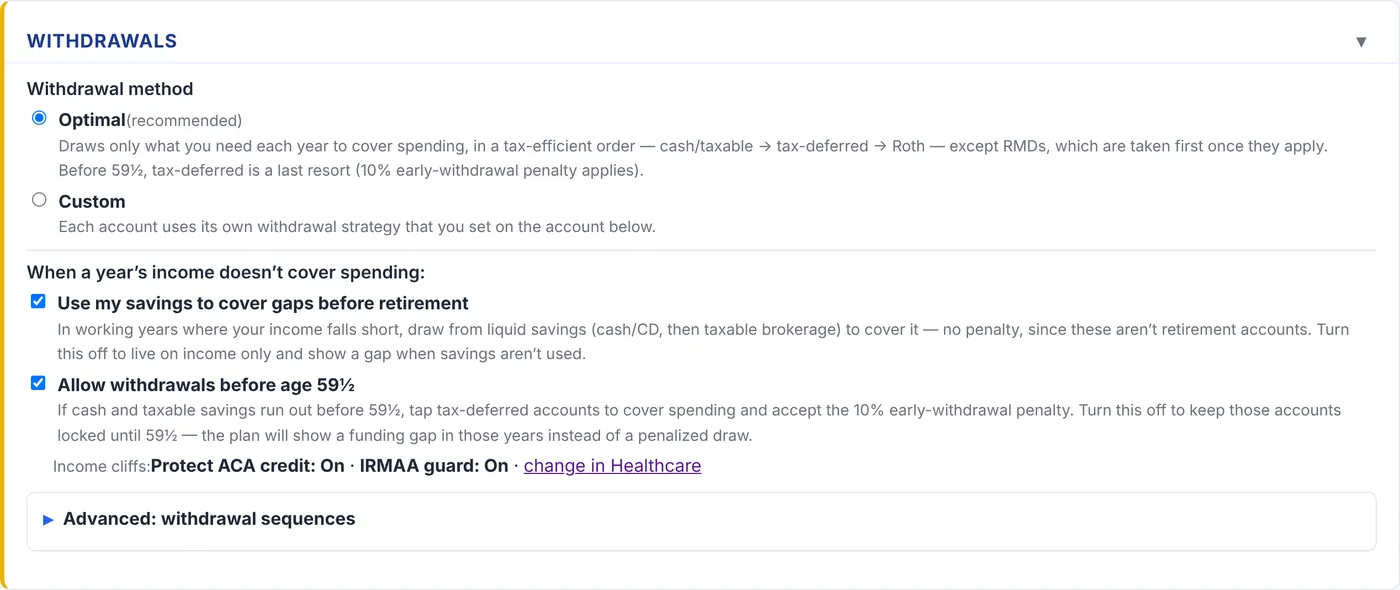
The app's Optimal mode draws only what each year needs, in a tax-smart order: it bridges the years before Social Security, avoids early-withdrawal penalties, applies the Rule of 55, takes RMDs automatically, and can stay under the ACA subsidy limit and IRMAA tiers. Or set your own withdrawal sequence by age.
Get the app free