Social Security planner: when to claim, and how much is taxed
Your Social Security check depends on the age you start it. Enter the monthly benefit at full retirement age from your Social Security statement to see what you would get at each age from 62 to 70.
Calculator
Your full retirement age: 67.
| Start at age | Each month | Each year | Compared with full retirement age |
|---|---|---|---|
| 62 | $1,750 | $21,000 | −30% |
| 63 | $1,875 | $22,500 | −25% |
| 64 | $2,000 | $24,000 | −20% |
| 65 | $2,167 | $26,004 | −13.3% |
| 66 | $2,333 | $27,996 | −6.7% |
| 67 | $2,500 | $30,000 | — |
| 68 | $2,700 | $32,400 | +8% |
| 69 | $2,900 | $34,800 | +16% |
| 70 | $3,100 | $37,200 | +24% |
Waiting from 62 to full retirement age pays off if you live past about age 79. Waiting from full retirement age to 70 pays off past about age 83.
Break-even ages compare total checks received, without cost-of-living raises or investment growth.
How much of your Social Security is taxable?
Up to 85% of your benefits can be taxed, depending on your other income. Enter one year's numbers:
Taxable Social Security: $13,850 — 46.2% of your benefits.
Combined income: $45,000 (other income plus half of your benefits).
🔒 This calculator runs in your browser. Nothing you type here is sent anywhere.
An estimate for planning, not tax or financial advice. It uses 2026 federal rules and leaves out state tax.
This app is an educational planning tool, not financial, tax or legal advice.
How the claiming age changes your check
Claiming before full retirement age lowers the check for life: by 5/9 of 1% for each of the first 36 months early, and 5/12 of 1% for each month after that — 30% less at 62 when full retirement age is 67. Waiting past full retirement age adds 8% a year until 70. After 70 there is nothing more to gain by waiting.
If you are married
The higher earner's claiming age also sets the survivor benefit: when one spouse dies, the survivor keeps the larger of the two checks. That is why the higher earner waiting to 70 often helps a couple, even when the break-even age looks late.
Why more of your benefit becomes taxable over time
The limits — $25,000 and $34,000 for a single filer, $32,000 and $44,000 for a married couple filing jointly — have never been raised for inflation. As pensions, withdrawals and required minimum distributions grow, more of your Social Security is pulled into taxable income. Roth conversions in the years before you claim can lower that later.
Questions people ask
What is the best age to claim Social Security?
There isn't one age for everyone. Claiming at 62 gives a smaller check for more years; waiting to 70 gives the largest check for life. Your health, other income, a spouse's benefits and taxes all matter. The break-even age above is a starting point; the app compares your whole plan at each age.
Is Social Security taxable?
It can be. If your combined income (other income plus half of your benefits) is $25,000 or less for a single filer, or $32,000 or less for a married couple filing jointly, none of it is taxed by the federal government. Above that, up to 50% and then up to 85% of your benefits count as taxable income. Most states don't tax Social Security.
What is full retirement age?
It is the age when you get your full benefit: 66 if you were born from 1943 to 1954, rising by two months a year to 67 for anyone born in 1960 or later.
Can I work while getting Social Security?
Yes. Before full retirement age, Social Security holds back part of your checks if your wages are above a yearly limit, and pays you back with a higher check later. From full retirement age there is no limit.
More free retirement planning tools
Plan it for your whole retirement — free
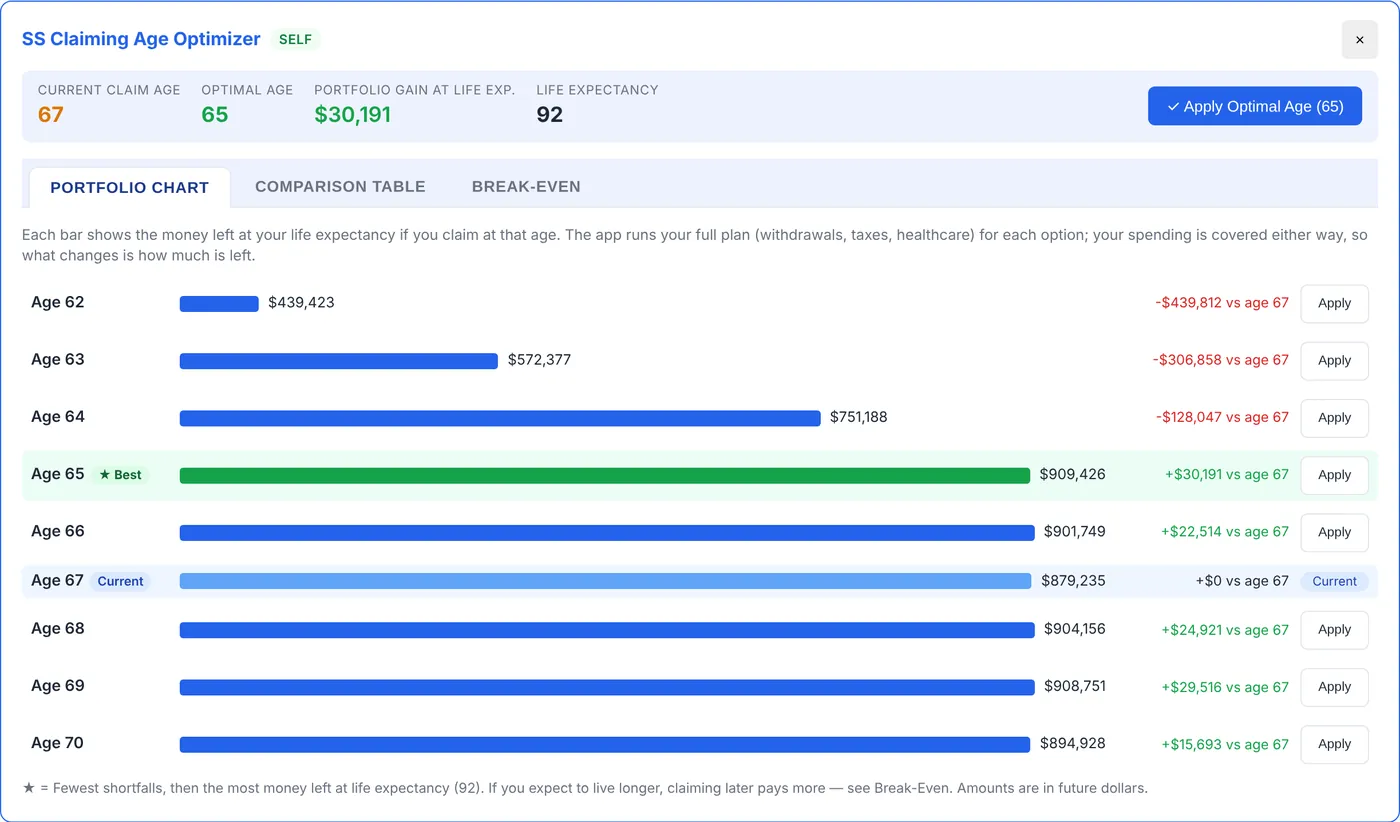
The app's Social Security optimizer runs your whole plan for every claiming age from 62 to 70 — with taxes, withdrawals and survivor benefits — and shows which age leaves you the most money.
Get the app free