Roth conversion calculator: how much can you convert and stay in your bracket?
A Roth conversion moves money from a traditional IRA or 401(k) to a Roth IRA. You pay income tax on it now, and qualified withdrawals later are tax-free. Many people convert just enough each year to fill a low tax bracket.
Calculator
You can convert about $88,300 and stay in the 12% bracket.
Federal tax on the conversion: about $10,350 (11.7% of the amount converted).
Your adjusted gross income after converting: $148,300. Medicare IRMAA starts above $218,000 — check it if you are 63 or older.
Top of the 12% bracket in 2026: $100,800 of taxable income.
🔒 This calculator runs in your browser. Nothing you type here is sent anywhere.
An estimate for planning, not tax or financial advice. It uses 2026 federal rules and leaves out state tax.
This app is an educational planning tool, not financial, tax or legal advice.
When a Roth conversion can pay off
- The years between retiring and starting Social Security or required minimum distributions, when your income — and your tax bracket — is low.
- When you expect a higher tax rate later: larger RMDs, a survivor filing single, or higher tax rates in the law.
- When you want to leave money to heirs: they inherit a Roth without income tax on it.
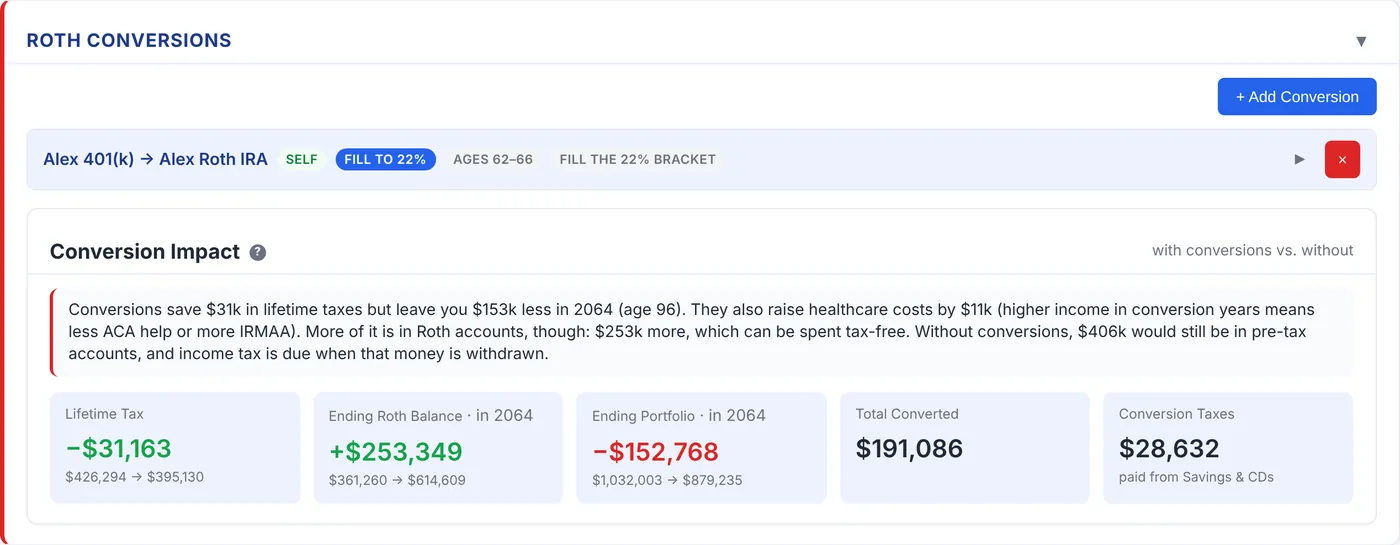
The hidden costs of converting
A conversion adds to your income for the year. It can pull more Social Security into taxable income, raise Medicare premiums two years later (IRMAA), cut an ACA health-insurance subsidy before 65, and reduce the senior deduction. Paying the tax from savings, not from the IRA, keeps more money growing tax-free.
Rules to know
Converted money has its own five-year clock for the 10% penalty if you take it out before 59½, and a conversion can't be undone. This calculator uses 2026 federal brackets and the standard deduction; it leaves out state tax, capital gains and itemized deductions.
Questions people ask
How much should I convert to a Roth each year?
A common approach is to convert up to the top of your current tax bracket — the calculator above shows that amount. Whether it pays off depends on your tax rate later, how long the money grows, and the costs in the year you convert.
Do I pay tax on a Roth conversion?
Yes. The converted amount counts as ordinary income in the year you convert. There is no 10% penalty on the conversion itself, even before 59½.
Does a Roth conversion affect Medicare premiums?
It can. Medicare uses your income from two years earlier, so a conversion at 63 or later can raise your Part B and Part D premiums through IRMAA. The IRMAA calculator shows the tiers.
Is there an income limit for Roth conversions?
No. Anyone with money in a traditional IRA, or a 401(k) that allows it, can convert, whatever their income. Income limits apply only to direct Roth IRA contributions.
More free retirement planning tools
Plan it for your whole retirement — free
The app plans conversions for every year — a fixed amount, or fill-to-bracket from one age to another — with optional caps so conversions don't push you into a higher IRMAA tier. It compares lifetime taxes with and without conversions and pays the tax from savings or a brokerage account.
Get the app free